

Robert P.Good, MD
Former Chief of Orthopaedics, Bryn Mawr Hospital & longtime Team Physician, Villanova Men’s Basketball

Caeruleum Biotechnologies, Inc. is a preclinical orthopaedic medical device company. The LunaFlex Meniscus is designed to restore physiologic load distribution across the tibiofemoral joint, to mitigate progression to post-traumatic osteoarthritis, and to give the joint a durable mechanical solution measured in decades rather than years.

Origin
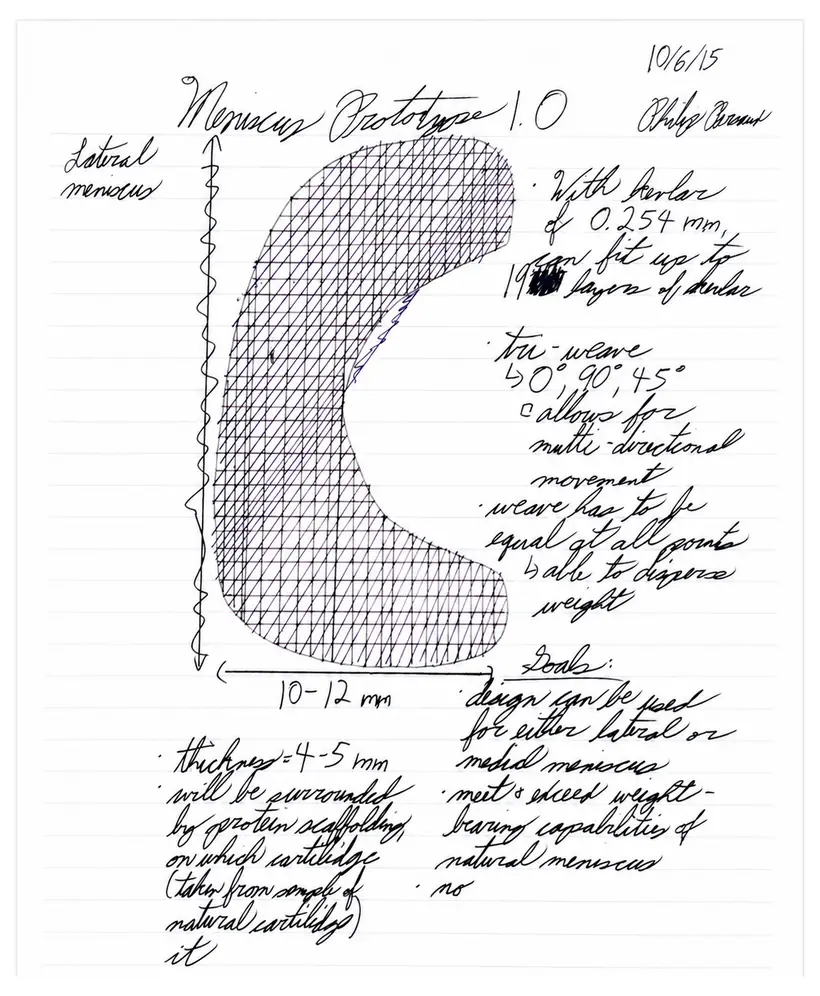
The first concepts and sketches for LunaFlex were developed in early October 2015. The earliest work began with a straightforward question: if damaged or missing meniscal tissue could not be repaired, could a synthetic structure be designed to restore the meniscus’s load-distributing role rather than simply remove more tissue?
That question became a long-running design program. The original concept evolved through repeated work on the implant’s geometry, fiber-reinforced structure, and intended implant fit and sizing. This research culminated in U.S. Patent No. 11,147,677, which was filed in January 2017 and granted in October 2021.
Over the following decade – as the paths of Caeruleum’s founders converged and led to the company’s formation in 2022 – the surgical technique, fixation structure, material selection, and market and regulatory positioning were refined. Caeruleum was built to carry that early invention forward as the LunaFlex platform and prepare the program for public launch.
Intellectual property
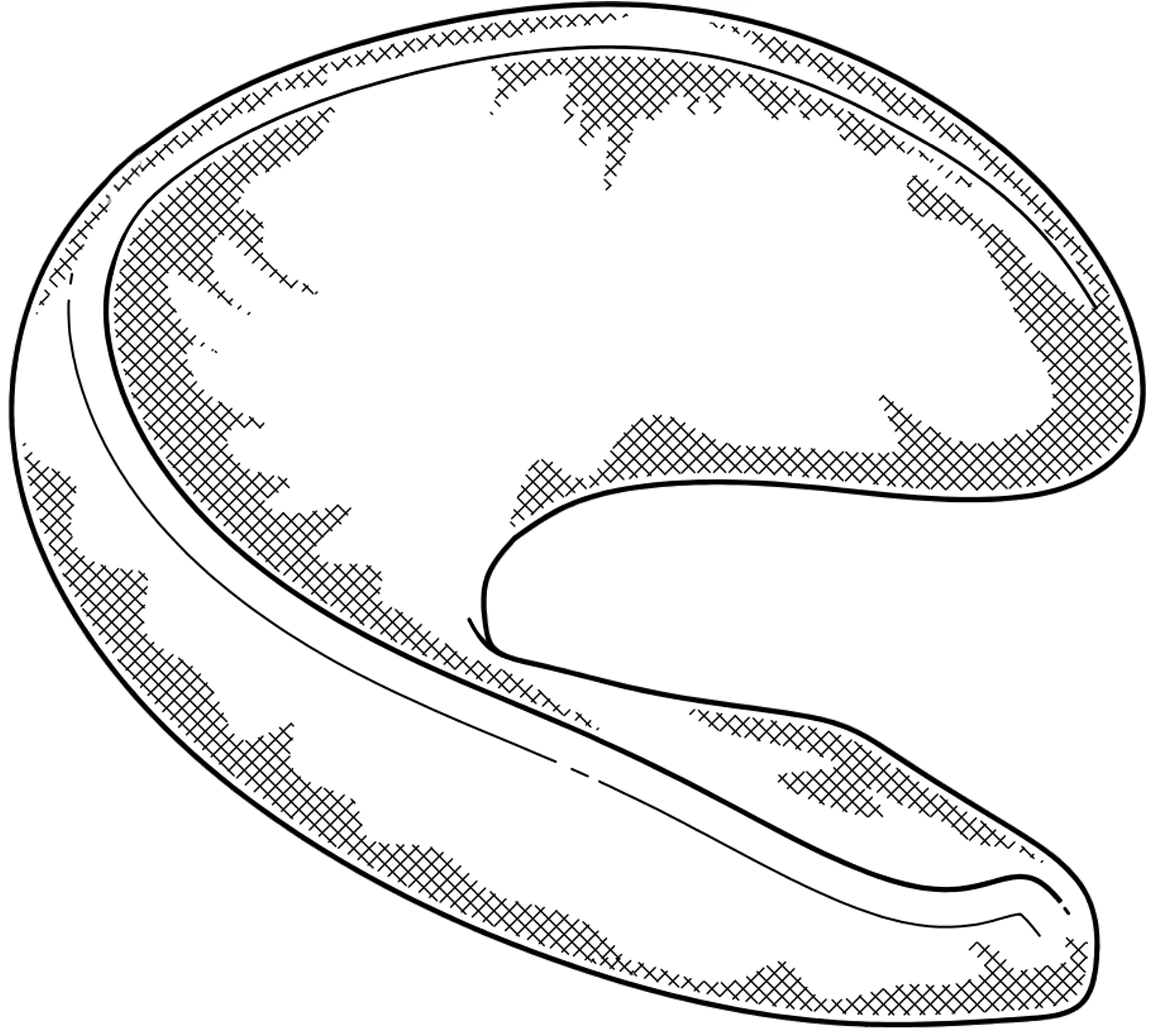
The intellectual property supporting Caeruleum’s LunaFlex program is anchored by U.S. Patent No. 11,147,677, “Artificial meniscus,” which describes a fiber-reinforced composite meniscus encased in a bioresorbable scaffold.
A further provisional patent application was filed in April 2026, extending the estate to the fixation system, surgical instruments, and AI- and machine-learning–enabled preoperative sizing and planning software.
The issued patent is a public document, and anyone evaluating the program can read its claims in full:
Why now
The design problem is old. What has changed recently is the ground it lands on.
A 2023 FDA advisory panel clarified what a meniscal implant in this class must demonstrate, providing a defined path for development and evaluation.
The materials behind the design have established safety histories and are already in production, reducing novel-material and supply-chain uncertainty.
Evidence questioning arthroscopic partial meniscectomy has increased payer interest in durable, joint-preserving alternatives that do not yet exist.
FDA Orthopaedic and Rehabilitation Devices Panel, 2023 · Sihvonen et al., FIDELITY, NEJM, 2013.
Clinical advisory board
Our clinical advisors bring experience in orthopaedic surgery, sports medicine, quality and safety, and health economics to the development of the LunaFlex program.
Former Chief of Orthopaedics, Bryn Mawr Hospital & longtime Team Physician, Villanova Men’s Basketball

Former Director of Orthopaedic Quality & Safety, Penn Medicine & Senior Fellow, Leonard Davis Institute

Sports Medicine Surgeon at Cooper University Hospital & Team Physician for Rowan University Athletics

Former Chief Research & Science Officer & Board Trustee, Philadelphia College of Osteopathic Medicine
Continue exploring
Go deeper into the LunaFlex design or meet the people advancing it.